Csak 2026. március 27. – 2026. május 31. között

Aligner START

Vágj bele most
a láthatatlan fogszabályozásba!
Free consultation
Swiss quality

Mi vár Rád az Aligner START programban?

Egyedülálló kedvezmények, korlátozott ideig.

✔ 150.000 Ft garantált kedvezményt kapsz az aligner kezelés árából

✔ amennyiben május 31-ig elindítod a kezelést, részt veszel a sorsoláson, ahol:

🏆 a fődíj: 500.000 Ft kezelési jóváírás
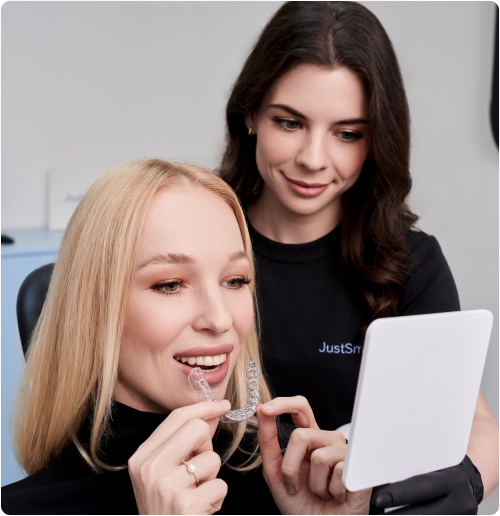
MIÉRT AZ ALIGNER?

Láthatatlan út a magabiztos mosolyhoz.
Láthatatlan megoldás
Digitálisan tervezett eredmény
Személyre szabott kezelés
Kényelmes, kivehető sínek

HOGYAN ZAJLIK?

Szakértői gondoskodás a kezelés egész ideje alatt.
1. Konzultáció és állapotfelmérés
2. Digitális lenyomatvétel és kezelési terv készítése
3. Aligner sínek átadása
4. Folyamatos kontroll a kezelés alatt
5. Retenciós fázis

Our results

Before & After

Indications

These are the main tooth malpositions, which are usually indicators for an aligner treatment.
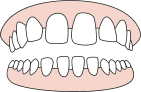
Crowding
Spacing
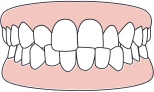
Deep / over bite
Open bite
Cross bite
  • Crowding occurs when the teeth do not have enough space next to each other in an arch. In addition to aesthetic problems, this discrepancy makes it more difficult to clean the teeth and can lead to gum inflammation, tartar and tooth decay more easily than with a normal set of teeth.
  • In contrast to crowded teeth, spacing is when the available space between the teeth is larger than needed. Most often a gap is formed between the two upper incisors, called diastema, but it can also occur in posterior regions. The plaque that easily sticks in the gaps can lead to gingivitis and tooth decay.
  • A deep bite is when the upper incisors cover more than 2 mm of the lower incisors in the closed position. This very common discrepancy affects nearly 70% of the population. It can lead to tooth wear, gum irritation and jaw joint problems.

  • Overbite is when the upper teeth are significantly more prominent than the lower teeth when closed. It can be hereditary or even caused by bad habits in childhood (tongue thrusting, finger sucking).
  • An open bite is when the upper and lower incisors do not come into contact in a closed position. It can be hereditary or acquired. In childhood, prolonged pacifier sucking, finger sucking, tongue thrust swallowing and mouth breathing can all be predisposing factors.

    Open bites can cause not only aesthetic problems but also chewing and speech difficulties.
  • Crossbite can affect a single tooth or even whole groups of teeth.
    Anterior crossbite is when the lower teeth bite in front of the upper teeth.
    Lateral crossbite is when the upper teeth bite inwards more than ideal because of a narrower upper jaw or wider lower jaw.


    This can result in asymmetry, speech and joint problems and abnormal tooth wear.
Crowding
  • Crowding occurs when the teeth do not have enough space next to each other in an arch. In addition to aesthetic problems, this discrepancy makes it more difficult to clean the teeth and can lead to gum inflammation, tartar and tooth decay more easily than with a normal set of teeth.
Show descriptionHide description
Spacing
  • In contrast to crowded teeth, spacing is when the available space between the teeth is larger than needed. Most often a gap is formed between the two upper incisors, called diastema, but it can also occur in posterior regions. The plaque that easily sticks in the gaps can lead to gingivitis and tooth decay.
Show descriptionHide description
Deep / over bite
  • A deep bite is when the upper incisors cover more than 2 mm of the lower incisors in the closed position. This very common discrepancy affects nearly 70% of the population. It can lead to tooth wear, gum irritation and jaw joint problems.

  • Overbite is when the upper teeth are significantly more prominent than the lower teeth when closed. It can be hereditary or even caused by bad habits in childhood (tongue thrusting, finger sucking).
Show descriptionHide description
Open bite
  • An open bite is when the upper and lower incisors do not come into contact in a closed position. It can be hereditary or acquired. In childhood, prolonged pacifier sucking, finger sucking, tongue thrust swallowing and mouth breathing can all be predisposing factors.

    Open bites can cause not only aesthetic problems but also chewing and speech difficulties.
Show descriptionHide description
Cross Bite
  • Crossbite can affect a single tooth or even whole groups of teeth.
    Anterior crossbite is when the lower teeth bite in front of the upper teeth.
    Lateral crossbite is when the upper teeth bite inwards more than ideal because of a narrower upper jaw or wider lower jaw.


    This can result in asymmetry, speech and joint problems and abnormal tooth wear.
Show descriptionHide description

Frequently asked questions

You still have questions? Please read our FAQ's or come see us at our practice!

IPR (interproximal reduction), also known as stripping, is actually a minimal reduction in the width of the teeth. This is necessary when you want to create space for the teeth to be properly aligned within an arch. This way, malocclusion can be resolved without the need for tooth extraction. IPR is a very common and well-established technique in orthodontic treatment. It is important to emphasize that it does not cause any problems later on and does not reduce the life and resistance of the teeth.

Until the small gap is closed during the treatment, great emphasis should be placed on thoroughly cleaning the resulting space using dental cleaning brushes, which our colleagues will teach you during the treatment.

Share the FAQ
  • Mezialization is an orthodontic procedure in which the teeth are moved along the occlusal plane towards the midline of the jawbone. The aim of the procedure is to improve the bite and the aesthetics of the dentition.
  • Distalization involves moving the teeth towards the back of the jaw (distal direction). This procedure is often used in cases where space needs to be created in a crowded, protruding or functionally inadequate dentition.
Share the FAQ

In some cases a refinement might be required to achieve the desired result. A refinement usually includes a new 3D scan and additional aligners.

Share the FAQ

A retainer is a device that keeps your teeth in position after your treatment. We offer two types of retainers:


  1. Wire retainer: We recommend a bonded wire retainer as it is the most effective at preventing your teeth from moving out of their new position. Wire retainers can last up to 20 years or more, and our JustSmile retainer has a 5-year guarantee.
  2. Splint retainer: The splint retainer is similar to an aligner, but usually has more layers and is thicker. It only prevents your teeth from shifting out of their new position, if you wear them at least during night.
Share the FAQ
1 3 4 5 6 7 20

Pricing

Monthly instalments
Single payment
You can freely choose the amount of your down payment, monthly installments and the duration within the credit conditions given by our partner bank.
Free whitening included!

Light


Description: Mostly short aesthetic cases.

From
75
/month*
Free whitening included!

Moderate


Description: Moderately severe aesthetic and functional cases.
From
95
/month*
Free whitening included!

Advanced


Description: Complex functional and aesthetic cases.
From
125
/month*
Currently we offer the treatment only for people over 16 years old.
*Instalments terms & conditions. THM 19.9%
Free whitening included!

Light


Description: Mostly short aesthetic cases.

From
1'465
Free whitening included!

Moderate


Description: Moderately severe aesthetic and functional cases.
From
2'360
Free whitening included!

Advanced


Description: Complex functional and aesthetic cases.
From
3'340
Currently we offer the treatment only for people over 16 years old.

Ready to JustSmile?

Book your appointment online and come visit us!
Free consultation
Free consultation
earthlinkcrosschevron-upchevron-down